

Choosing the right 360 feedback software can make the difference between feedback that actually drives growth — and a process everyone dreads. The market is crowded, and most comparison articles just list features without telling you what actually matters for your team.
We reviewed dozens of 360 degree feedback tools and narrowed the list to 12 that stand out. This guide covers pricing, standout features, and which type of company each tool fits best — so you can make a confident decision without wasting time on demos that aren’t right for you.
TL;DR: Best 360 Feedback Software at a Glance
- Culture Amp — Enterprise-grade 360 assessments backed by people science and engagement data.
- Lattice — Full performance suite with 360 feedback built into reviews, goals, and development.
- Effy AI — AI-powered 360 feedback with a generous free plan, built for SMBs who want fast setup.
- Qualtrics — Advanced analytics and reporting for large organizations with complex feedback needs.
- Spidergap — Simple, focused 360 tool that charges per assessment instead of per seat.
- Leapsome — All-in-one people enablement platform combining 360s with OKRs and engagement.
- 15Five — Manager effectiveness platform where 360 feedback supports coaching conversations.
- Primalogik — Flexible 360 surveys with full control over question design and rating scales.
- Trakstar Perform — Straightforward 360 review module inside a broader performance management system.
- Betterworks — Enterprise performance platform connecting 360 feedback to OKRs and development plans.
- Teamflect — 360 feedback built entirely inside Microsoft Teams for M365-heavy organizations.
- Rippling — Unified HR platform with 360 reviews powered by a single employee data source.
What Is 360 Feedback Software?
360 feedback software collects performance feedback from multiple sources — managers, peers, direct reports, and sometimes external stakeholders — instead of relying on a single top-down review.
The goal is to give employees a well-rounded view of their strengths and development areas. Rather than one manager’s perspective, they get input from everyone they work with regularly.
Good 360 degree feedback software automates this process: it distributes surveys, tracks completion, anonymizes responses where needed, and generates reports that are actually useful. Some tools go further by using AI to summarize themes, flag blind spots, and suggest development actions.
How We Evaluated These Tools
We assessed each 360 feedback tool across five criteria that matter most for HR teams:
- Ease of setup and use — How quickly can a non-technical HR manager launch a 360 review cycle?
- Customization — Can you build your own questionnaires, or are you locked into templates?
- Reporting and insights — Does the tool just collect data, or does it help you understand it?
- Pricing transparency — Is pricing clear and fair for small and mid-sized teams?
- Integration fit — Does it work with your existing HRIS, Slack, Teams, or other tools?
{{banner-4="/banner-page"}}
12 Best 360 Degree Feedback Software
1. Culture Amp
Best for: Enterprise and mid-market companies focused on engagement analytics alongside 360 feedback.
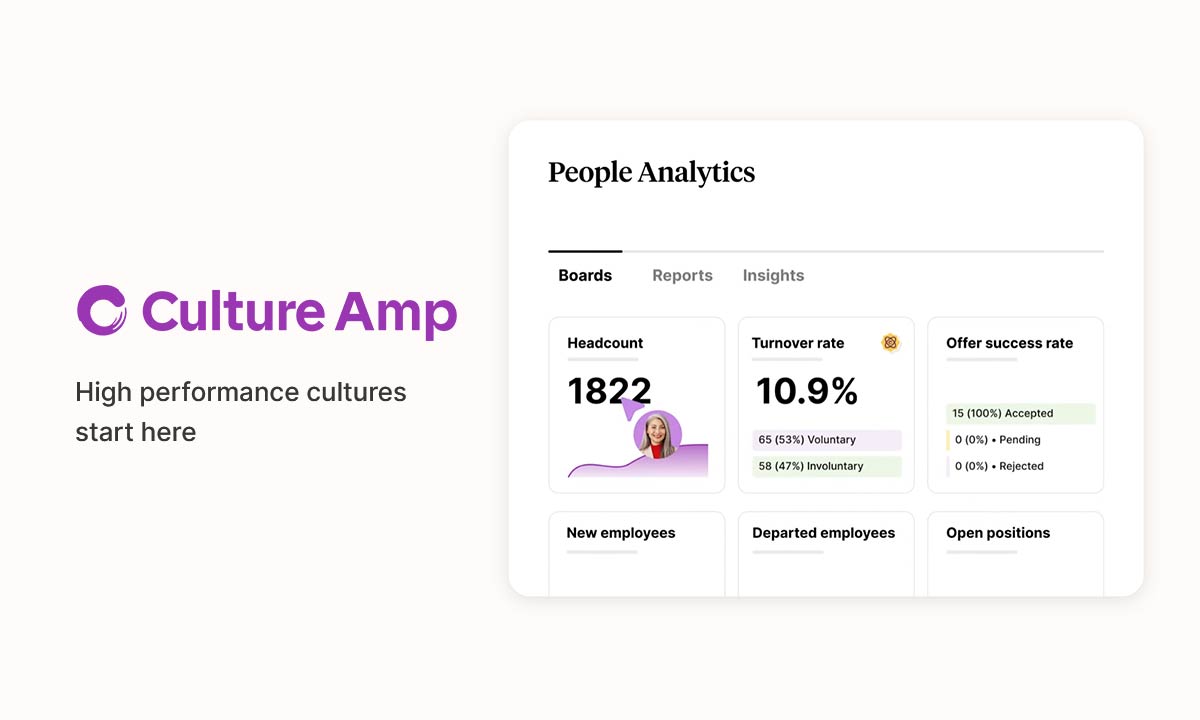
Culture Amp combines 360 degree feedback with employee engagement surveys, giving HR teams a unified view of performance and culture. The platform is backed by organizational psychologists and includes a library of science-backed survey templates.
Its reporting stands out — you get heat maps, gap analysis between self-ratings and peer ratings, and benchmarks against industry data. For organizations that want to tie 360 feedback to broader people analytics, Culture Amp is one of the strongest options.
Key features:
- Science-backed 360 assessment templates
- Gap analysis between self and peer ratings
- Industry benchmarking data
- Integration with HRIS platforms like Workday and BambooHR
Pricing: Custom pricing. Generally starts around $4–5 per employee/month for mid-market plans.
Best for teams that: Already invest in engagement surveys and want 360 feedback tied into the same ecosystem.
2. Lattice
Best for: Growing companies that want 360 feedback inside a full performance management suite.
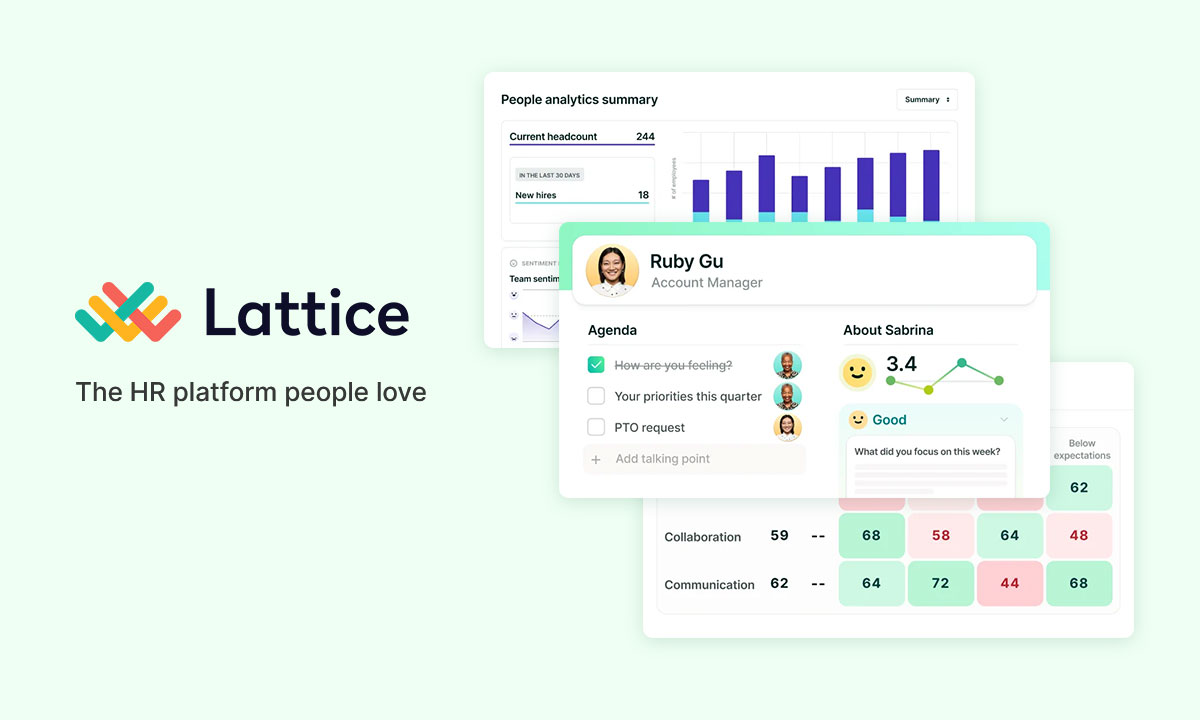
Lattice is one of the most popular performance management platforms, and its 360 feedback module is tightly integrated with reviews, goals, compensation, and career development. You can run standalone 360 assessments or embed multi-rater feedback directly into your regular review cycles.
The platform is well-designed and easy for both HR admins and employees to navigate. If your team already uses Lattice (or wants a one-stop platform), adding 360s is straightforward.
Key features:
- 360 feedback embedded in performance review cycles
- Customizable competency frameworks
- Manager and peer nomination workflows
- Analytics dashboards with response tracking
Pricing: Starts at $11/person/month for the base plan. 360 feedback is available in higher tiers.
Best for teams that: Want one platform for reviews, goals, compensation, and 360 feedback.
3. Effy AI
{{banner-2="/banner-page"}}
Best for: Small and mid-sized businesses that want AI-powered 360 feedback without the enterprise price tag.
Effy AI is an AI-powered performance management tool built specifically for SMBs. It makes running 360 feedback reviews fast and simple — you can launch a review cycle in minutes using ready-made templates or custom forms.
What sets Effy AI apart is its AI-generated review summaries. Instead of reading through dozens of individual responses, managers get an AI summary that highlights key themes, strengths, and development areas. This saves hours of manual analysis, especially for teams running their first 360 process.
The free plan includes unlimited team members and reviews, making it one of the most accessible 360 feedback tools for small teams just getting started.
Key features:
- AI-powered feedback summaries and insights
- Ready-made 360 feedback templates
- Slack and Microsoft Teams integration for easy feedback collection
- Unlimited members and reviews on the free plan
- Multiple review types: 360, peer, manager, and self reviews
Pricing: Free plan available (unlimited members and reviews). Paid plans start at $2.50/person/month.
Best for teams that: Are running 360 feedback for the first time or want AI to handle the analysis.
{{banner-7="/banner-page"}}
4. Qualtrics 360 Development
Best for: Large enterprises that need deep analytics and customization for their 360 programs.
Qualtrics brings its survey expertise to 360 degree feedback with one of the most powerful analytics engines on the market. You get advanced reporting with role-based dashboards, competency gap analysis, and action planning tools built into the platform.
The setup is more complex than lighter tools — Qualtrics is designed for organizations with dedicated People Analytics teams who want full control over survey design, distribution logic, and reporting.
Key features:
- Advanced competency gap analysis
- Role-based reporting dashboards
- Action planning tools built into feedback reports
- Flexible survey logic and branching
Pricing: Custom enterprise pricing. Typically requires annual contracts.
Best for teams that: Have a dedicated People Analytics function and need advanced customization.
5. Spidergap
Best for: Companies that want a simple, focused 360 feedback tool without performance management overhead.
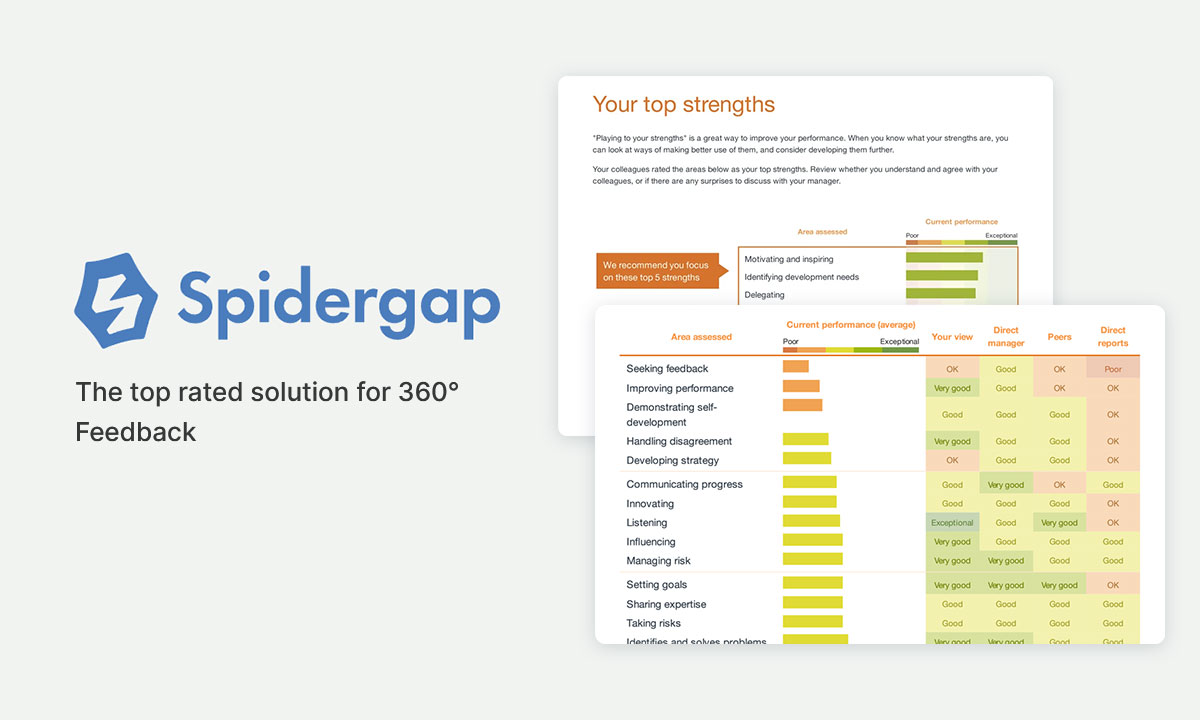
Spidergap does one thing and does it well: 360 degree feedback. Unlike platforms that bundle 360s with reviews, goals, and engagement, Spidergap focuses entirely on the 360 process — from questionnaire design to participant management to report generation.
Its pricing model is also unique: you pay per assessment rather than per seat, which can be more cost-effective for companies that run 360 reviews annually or semi-annually rather than continuously.
Key features:
- Dedicated 360 feedback platform with no bloat
- Pay-per-assessment pricing model
- Individual development plan generation from feedback data
- Branded PDF reports for participants
Pricing: $44–89 per employee per assessment, depending on volume.
Best for teams that: Run 360s periodically (not continuously) and want a specialist tool.
6. Leapsome
Best for: People-first companies that want 360 feedback alongside OKRs, engagement, and learning.
Leapsome is an all-in-one people enablement platform that combines 360 feedback with goal management, engagement surveys, learning, and compensation management. Its 360 module lets you build fully customized review cycles with multi-rater feedback and competency frameworks.
The platform is popular in Europe and is particularly strong for companies that want a continuous feedback culture — not just annual 360 assessments.
Key features:
- Customizable 360 review cycles with multi-rater support
- Competency frameworks and skill matrices
- Integrated with OKRs, engagement, and learning modules
- Strong compliance features (GDPR, data residency)
Pricing: Starts at $3/user/month. 360 feedback included in Performance module.
Best for teams that: Want a European-headquartered platform with strong privacy compliance and an all-in-one approach.
7. 15Five
Best for: Organizations focused on manager development and coaching-driven feedback.
15Five approaches 360 feedback differently — it’s built around the philosophy that feedback should drive continuous coaching conversations, not just produce annual reports. The platform combines 360 assessments with weekly check-ins, 1-on-1 meeting tools, and engagement surveys.
Its “Best-Self Review” model incorporates multi-rater feedback into a review process designed to be strengths-focused rather than deficit-oriented.
Key features:
- Best-Self Review with 360 feedback integration
- Weekly check-ins and 1-on-1 agenda tools
- Manager effectiveness assessments
- Engagement surveys with action planning
Pricing: Starts at $4/user/month. 360 feedback available in the Total Platform plan.
Best for teams that: Prioritize manager coaching and continuous feedback over formal review cycles.
8. Primalogik
Best for: HR teams that want full control over their 360 survey design and process.
Primalogik gives you more flexibility in 360 questionnaire design than most competitors. You can build your own surveys from scratch, choose from 3-point to 10-point rating scales, mix question types, and set up custom competency models.
The platform also handles the logistics well — automated email reminders, batch launches for multiple 360 cycles, and configurable anonymity settings.
Key features:
- Fully customizable 360 questionnaires
- Flexible rating scales (3-point to 10-point)
- Automated reminders and batch launches
- Configurable anonymity and visibility settings
Pricing: Starts at $4/user/month.
Best for teams that: Need granular control over survey design and have specific competency frameworks they want to map.
9. Trakstar Perform
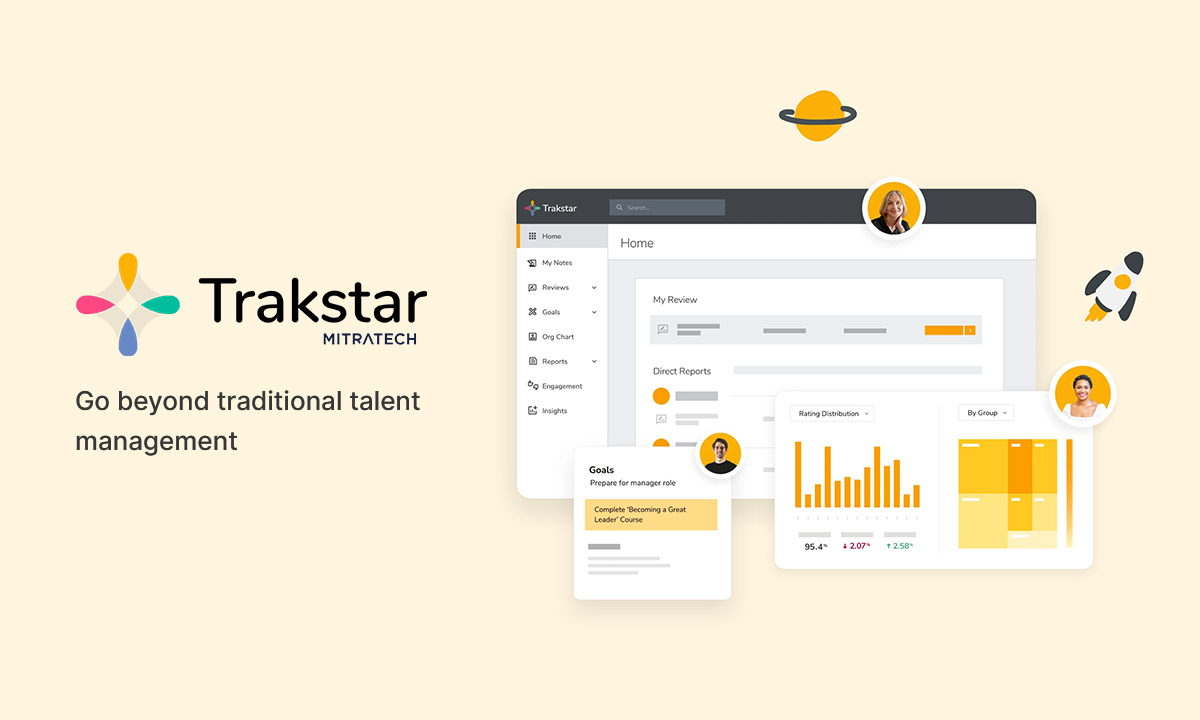
Best for: Mid-sized companies that want a no-frills performance management system with 360 capability.
Trakstar Perform offers a straightforward performance management platform with built-in 360 review functionality. It’s not the most feature-rich option, but it’s reliable and easy to implement.
The 360 module lets you collect feedback from peers, direct reports, and managers using customizable templates. Reports are clean and easy to share with participants.
Key features:
- Built-in 360 feedback within performance reviews
- Customizable review templates
- Goal tracking and alignment
- Succession planning tools
Pricing: Custom pricing based on company size.
Best for teams that: Want 360 feedback as part of a simple, traditional performance review system.
10. Betterworks
Best for: Enterprise organizations aligning 360 feedback with OKRs and strategic goals.
Betterworks connects 360 degree feedback to the broader performance ecosystem — OKRs, check-ins, calibration, and development plans. It’s designed for large organizations where feedback needs to flow across departments and align with company-wide objectives.
The platform includes AI-powered theme analysis that identifies patterns across feedback responses, which is useful when running 360s at scale.
Key features:
- 360 feedback connected to OKRs and development plans
- AI-powered theme and sentiment analysis
- Configurable anonymity and bias detection
- Calibration tools for cross-team consistency
Pricing: Custom enterprise pricing.
Best for teams that: Have 500+ employees and want 360 feedback integrated with OKR-driven performance management.
11. Teamflect
Best for: Microsoft 365-native organizations that want 360 feedback inside Teams.
Teamflect is built entirely within Microsoft Teams, which means employees never need to switch to a separate app to give or receive 360 feedback. For organizations that live in the M365 ecosystem, this eliminates the adoption friction that kills many feedback initiatives.
The platform is free for up to 10 users, making it an easy starting point for small teams.
Key features:
- Fully embedded in Microsoft Teams
- 360 feedback, reviews, goals, and recognition in one platform
- Free for teams up to 10 users
- No separate login or app required
Pricing: Free for up to 10 users. Paid plans start at $5/user/month.
Best for teams that: Use Microsoft Teams daily and want zero-friction feedback collection.
12. Rippling
Best for: Companies that want 360 feedback inside a unified HR and IT platform.
Rippling’s approach to 360 feedback is unique — it sits inside a platform that also handles payroll, benefits, IT, and device management. Every HR app in Rippling is powered by a single employee data source, so 360 feedback results can be connected to broader workforce data.
This makes Rippling a strong choice for companies that want to consolidate HR tools rather than add another point solution.
Key features:
- 360 feedback powered by unified employee data
- Customizable review templates and cycles
- Part of a broader HR, IT, and finance platform
- Automated workflows triggered by review outcomes
Pricing: Custom pricing. Rippling uses modular pricing where you pay for the features you need.
Best for teams that: Want to consolidate HR, IT, and performance management into one platform.
Key Features to Look for in 360 Feedback Software
Not every tool above is the right fit for every team. Here’s what to prioritize based on your situation:
Customizable questionnaires. You should be able to create your own questions, adjust rating scales, and map feedback to your specific competency framework — not just use generic templates.
Anonymity controls. Employees won’t give honest feedback if they think their responses can be traced. Look for tools that let you configure anonymity settings and set minimum response thresholds before results are revealed.
AI-powered analysis. Manually reading and summarizing dozens of feedback responses per person is slow and inconsistent. Tools with AI summaries (like Effy AI) save hours and surface patterns that humans miss.
Clear, actionable reports. A good 360 feedback report doesn’t just show scores — it highlights gaps between self-perception and peer perception, identifies development priorities, and suggests next steps.
Integration with your workflow. The best 360 feedback software meets people where they work. Slack, Microsoft Teams, HRIS, and calendar integrations reduce friction and boost response rates.
How to Choose the Right 360 Feedback Tool
Start with your team size and budget:
- Under 50 employees: Look at Effy AI (free plan, AI summaries), Teamflect (free for 10 users), or Spidergap (pay per assessment).
- 50–500 employees: Consider Lattice, Leapsome, 15Five, or Primalogik — depending on whether you want a full performance suite or a focused 360 tool.
- 500+ employees: Evaluate Culture Amp, Qualtrics, or Betterworks for enterprise-grade analytics and customization.
Then consider your workflow:
- Microsoft Teams shop? Teamflect.
- Need just 360 feedback, nothing else? Spidergap.
- Want AI to do the heavy lifting? Effy AI.
- Already using an HRIS? Check which tools integrate with it before committing.
Finally, run a pilot. Most 360 feedback tools offer free trials or free plans. Test with a small group before rolling out company-wide — you’ll learn more from 30 minutes of real use than from 10 demo calls.
💡 Related reading: Check out our guide to performance management software for small business and explore strengths and areas of improvement examples to make the most of your 360 feedback results.

