A career framework made for your company: tracks, levels and competencies, plus promotion signals, anti-patterns, growth opportunities and assignment criteria for every level.
Build your career framework
Each manager runs 1-on-1s their own way. Employees get feedback, but not what their role expects or how to reach the next step. Development plans exist on two or three teams.
That gap has a name: no career framework. Per role, per level, what the job looks like and what the next one asks.
Before AI, building one took a quarter. Now, a day.
Here's the skill that drafts yours in fifteen minutes and gets it to managers for approval today.
What you'll have at the end
A career framework built specifically for your company: the career paths and levels that fit your roles and your size, drawn from your own job descriptions, org chart and titles. Not a template with the blanks pre-filled.
Concretely:
→ Tracks as role clusters. Engineering, Product, Go-to-market, Operations. Four or five, not one per job title. A track per title is the first thing a model will offer and the first thing that collapses under maintenance.
→ A shared layer of competencies. Four to six that apply to everyone (how you communicate, how you handle scope, how you work with others), plus a short overlay per track for what's specific to the craft. Monzo's pattern, and the one that keeps the framework readable.
→ Five or six levels, with more rungs at the junior end than the senior end, because that's where people actually move.
→ An expectations matrix. For each competency, a few plain-language lines per level: what someone at this level does, in observable terms. Not what they are.
→ Promotion signals and anti-patterns per level. What it looks like when someone already works at the next level, and what holds them where they are even when the output looks fine.
→ Growth opportunities, the next career steps. Two to four concrete assignments per level that develop the next one.
→ Assignment criteria, how to tell which level a person belongs on, and the assigned people per level.
Every expectation traces to a job description, an existing document, or your answer.
How the build runs
Three steps, and each ends with a pause where you confirm.
Research. Effy reads your job descriptions, org chart and titles, plus anything that already describes how people grow here, and reports back: which roles exist, how titles cluster, where the JDs contradict each other.
Skeleton. Up to eight questions about what the documents didn't answer, then a one-page proposal: tracks, competencies, level names and count, an owner per track. You edit, you approve. Nothing gets written until you do.
Write. The full matrix, expectations and the four rows per level, straight into Career paths in Effy. Then it stops. Publishing to your team is a separate decision, made after manager review, by you.
The pauses are the design. A wrong assumption caught after research costs a sentence. The same one caught by a manager in review costs a week.
Before you start
You need an Effy AI free account. It comes with the skills library, and the library has the skill for creating and editing a career framework.
If you already have one connected, skip to the 'Run it'.
If you don't, two steps:
- Sign up for a free account. Google or Microsoft login works.
- Connect it to your AI.
→ Claude on a Team or Enterprise plan: ask your admin to allow the Effy AI connection. Admins control which connectors the organisation can use.
→ Claude on a personal plan: add Effy AI from the connector library in settings.
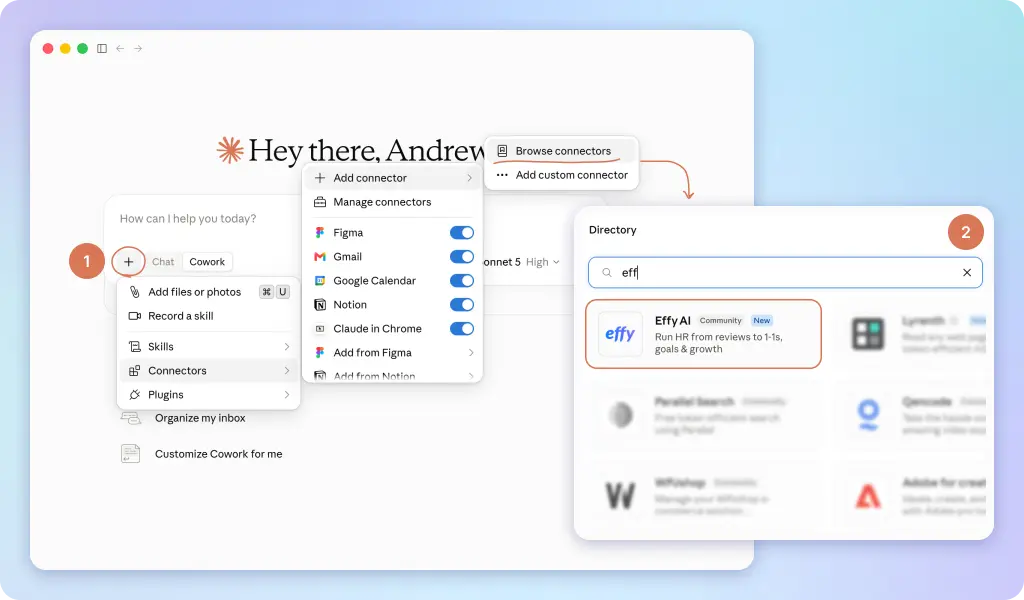
→ ChatGPT or Copilot: add Effy AI as a custom app. Turn on Developer Mode first, then:
- Go to Settings, then Apps, and click Create.
- Fill in the server details: Name: Effy AI; MCP Server URL:
https://go.effy.ai/mcp;Authentication: OAuth - Complete the OAuth sign-in with your Effy AI account.
Then gather the inputs, in whatever shape they exist:
→ Your job descriptions, current ones and the ones you hired from last year.
→ The org chart, or a list of people with title, team and manager. Names can be replaced with role codes if your policy says so; the framework doesn't need them.
→ Your title list, including the titles you regret.
Run it
With Effy AI, connected as above, just write: "effy, create a career framework" or hit the link for whatever you're using:
If anything doesn't work, or you can't sign up, reach out to me: a.makhovskyi@effy.ai
Next steps
Two things happen after the draft, and they're the actual work.
Approve it with managers. Send each manager the levels their team sits on, not the whole framework. Give the track owner two weeks and a clear job: the content is theirs to rewrite, HR only holds the format. Collect comments per cell, group them for the owner, one review round. A track publishes when every manager with people on it has signed off, or when you override with a written reason. Then publish, labelled version 1, with the owner's name on it.
Level the people you already have. Separately, after publishing, and conservatively. Ask for self-assessments before manager ratings; Upwave and Thumbtack both found managers and employees mostly agree, and the disagreements are the calibration meeting. Never propose a level below someone's current one during a framework change. And keep the first pass private until managers have seen it.
Use it in the next cycle. Once people have levels, the framework stops being a document and starts being an input. Every 1-on-1 prep can carry the person's current and next-level expectations. Every growth plan can start from the gap. Every promotion case can cite evidence against the level above instead of adjectives. That's the loop the framework was for, and it's the next lesson.
That December line, "work on strategic thinking"? Next cycle it's a cell in the matrix, with a name, a next level, and a 1-on-1 where someone opens it.
Click. Try. Use.
Thank you! Your submission has been received!
Oops! Something went wrong while submitting the form.