

Every list of performance appraisal software tells you what the tools do. Almost none tell you what they cost — because half the vendors in this category don't publish a price.
So we checked. Every figure below came from the vendor's own pricing page in September 2026. Where a vendor publishes nothing, we say "not published" instead of repeating a number some aggregator guessed. We also flag the minimums and contract terms, which is where the real cost usually hides: one platform on this list charges a $4,000 annual floor, another bills a flat $4,999 a year no matter how many people you have.
Here are twelve employee evaluation software platforms worth your shortlist, what each is actually good at, and what you'll really pay.
TL;DR — Quick Comparison
- Effy AI — $3/seat/month, free up to 5 users, no minimums or contracts. Best for teams that want a cycle running this week.
- AssessTEAM — $2/user/month billed annually, no minimum team size. Best cheapest published price.
- Small Improvements — $3/user/month annually, 20-user minimum. Best budget option once you're past 20 people.
- PerformYard — $5–10/person/month annually, undisclosed minimum. Best for custom review workflows.
- 15Five — Perform tier $11/user/month, annual only. Best for building manager capability.
- Lattice — $13/seat/month, $4,000 annual minimum. Best for companies scaling past 200.
- BambooHR — Reviews require the Pro tier at $17/employee/month. Best all-in-one HR platform.
- Zoho People — Performance from $3.50/user/month globally, $6 in the US. Best for tight budgets.
- Culture Amp — Not published, annual billing only. Best for engagement-led performance strategy.
- Leapsome — Not published, one-year minimum term. Best for performance plus L&D.
- Trakstar Perform — Not published. Best for structured, audit-ready appraisals.
- Workleap — $4,999/year flat, not per seat. Best for engagement-first teams above 100 people.
Appraisal Software, Evaluation Software, Review Software — What's the Difference?
These terms get used interchangeably in marketing copy, which makes shopping harder than it needs to be. Here's the practical distinction.
Performance review software runs the review itself: forms, rating scales, self-assessments, peer and manager input, and sign-off. It's the narrowest and most common category.
Performance evaluation software is the same thing under a different name. Some vendors prefer "evaluation" because "review" sounds like an annual ritual, but the functionality is identical. If you're searching for performance evaluation software, everything on this list qualifies.
A performance review system usually implies something broader — the review plus goals, check-ins, and continuous feedback. If that's what you're after, our guide to performance management systems covers the wider category, and performance management software compares the full-suite platforms.
Online performance review software just means cloud-hosted, which every tool on this list is. The phrase is a holdover from when the alternative was a desktop install or a paper form. Ignore it as a filter.
Performance appraisal software is the oldest term of the set and still the most common in HR job descriptions and RFPs. It usually implies a formal, rated, once-or-twice-a-year assessment with an audit trail behind it.
Employee evaluation software and employee review software are the same category in plainer language — what a manager searches for when nobody has told them the HR term for it.
Vendors use all of these labels interchangeably, so filter on what the tool actually does — rating scales, review types, who can see what, what happens to the record afterwards — rather than the word on the pricing page.
What to Look for in Employee Evaluation Software
Six things separate a platform your managers use from one that stalls at 40% completion.
Published pricing
Trakstar, Leapsome, and Culture Amp publish nothing at all. PerformYard publishes a range and gates the real number behind a form. That's a legitimate business model, but it costs you two weeks of sales calls before you can even build a shortlist. Factor that into your timeline, not just your budget.
Minimums, not just per-seat rates
This is the number that decides affordability. Lattice's $4,000 annual floor means a 25-person company pays $160 per employee before running a single review. Small Improvements has a 20-user minimum, so a 12-person team buys 20 seats. Workleap charges $4,999 a year flat — reasonable at 150 people, punishing at 30.
Multiply the per-seat rate by your real headcount, then compare it to the minimum. Whichever is higher is your actual price.
Review flexibility
Can you run 360-degree reviews, self-assessments, manager reviews, peer feedback, and probation checks from the same platform? Most companies start with one review type and add others within a year. Rebuilding your setup because the tool only does annual appraisals is a waste of a quarter.
AI that does the writing, not just the summarizing
The bottleneck in any review cycle is managers staring at a blank text box. Tools that generate draft forms, prompt follow-ups on thin answers, and produce written summaries remove the part people actually procrastinate on. Summarization alone doesn't fix the blank page.
It lives where your team already works
Adoption drops fast when reviews mean logging into a fifth tool. Slack and Microsoft Teams integration is usually the difference between a cycle that finishes and one you spend three weeks chasing.
Setup measured in days
If a vendor talks about implementation consultants or a discovery phase, budget weeks. Tools built for self-serve buyers get you live in a day.
The 12 Best Performance Appraisal Software Platforms
1. Effy AI — Best Overall
{{banner-3="/banner-page"}}
Effy AI is built for teams that need structured reviews without an HR ops function to run them. AI generates the review forms, sends the reminders, nudges thin feedback, and writes the summaries — so one person can run a full 360 cycle without becoming a project manager.
The commercial terms are the standout: no seat minimums, no contracts, no implementation fees, pro-rated billing as headcount moves, and a pay-per-cycle option if you only run reviews once a year.
Key features:
- AI-generated review forms and written summaries
- 360° feedback, self-assessments, manager and peer reviews
- Bias checks and quality nudges on written feedback
- Goals and OKRs, PDPs and PIPs, check-ins
- Heatmap and 9-box insights
- Runs inside Slack
Pricing: Free for up to 5 users. From $3/seat/month billed annually ($6 for multiple cycles per user per year). Goals and OKRs $2/seat/month. 30% nonprofit discount. See full pricing.
Best for: Teams of 10–300 that want reviews live within a week, with no procurement process.
Watch out for: Younger platform than the incumbents, so some edge-case reporting is still being built out.
2. AssessTEAM — Cheapest Published Price
AssessTEAM is the rare vendor in this category that publishes an exact per-user rate with no minimum team size and no contract. If price transparency is your filter, it clears the bar more cleanly than anything else here.
Key features: Evaluations and 360 feedback, KPI libraries by job role, project profitability tracking, time tracking on higher tiers, mobile apps.
Pricing: Evaluations plan $3/user/month billed monthly or $2/user/month billed annually. No minimum number of users — the pricing page states this explicitly. Time Tracking $4.50/$3, Profitability $6/$4. Above 100 employees, pricing moves to a quote.
Best for: Very small teams and cost-sensitive buyers, particularly project-based businesses that want performance tied to profitability data.
Watch out for: The 10-day trial is sales-assisted — the "start free trial" button books a call rather than creating an account.
3. Small Improvements — Best Budget Option Above 20 Seats
Small Improvements does structured reviews well and doesn't try to be a platform. That focus is the appeal.
Key features: Reviews and self-assessments, praise and recognition, 1:1 templates, objectives on higher tiers, Slack and Teams integrations.
Pricing: Launch $3/user/month, Grow $6, Elevate $9 — all billed annually. 20-user minimum (30 for Elevate). 30-day self-serve trial, no card required.
Best for: Teams of 20–100 that want reviews and nothing more.
Watch out for: The 20-user floor makes the effective price much higher if you're under 20 people. Monthly rates aren't published.
4. PerformYard — Best for Custom Review Workflows
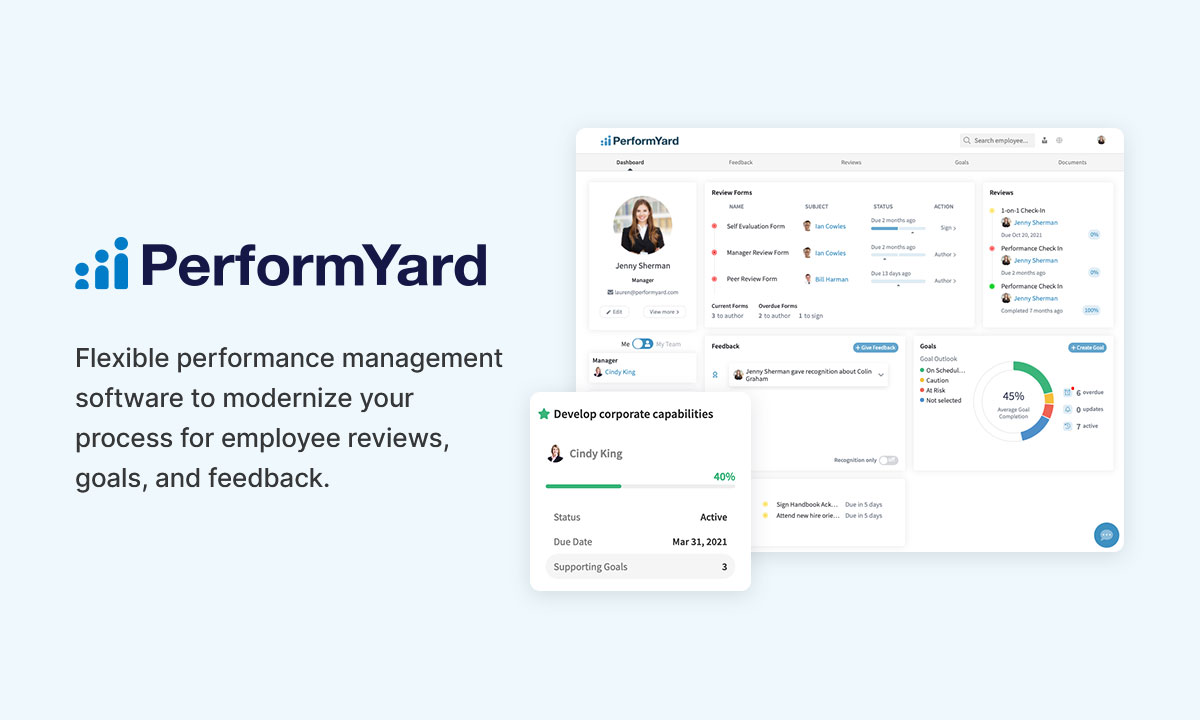
PerformYard gives you more control over review structure than almost anything else at this price. Custom cycles, your own rating scales, and workflows that mirror whatever process you already run.
Key features: Fully customizable review templates and cycles, goal management linked to reviews, continuous feedback, reporting dashboards.
Pricing: $5–10 per person per month billed annually. The site notes "minimum pricing applies" without stating the minimum; the real quote is form-gated.
Best for: Companies with an established review process they want software to match, not replace.
Watch out for: Less AI-native than newer tools, and you can't build a budget without a sales call.
5. 15Five — Best for Manager Development
15Five treats reviews as a manager-capability problem rather than a forms problem. Weekly check-ins, 1-on-1 agendas, and manager training sit alongside the cycle.
Key features: Weekly check-ins, 1-on-1s, OKRs, engagement surveys, manager coaching content, review cycles.
Pricing: Engage $4/user/month, Perform $11/user/month, Total Platform $16 — annual billing only. 14-day trial, form-gated.
Best for: Companies of 100–1,000 where the real problem is that managers don't know how to manage.
Watch out for: Annual billing only, and it's a lot of platform for a 30-person team.
6. Lattice — Best for Companies Scaling Past 200
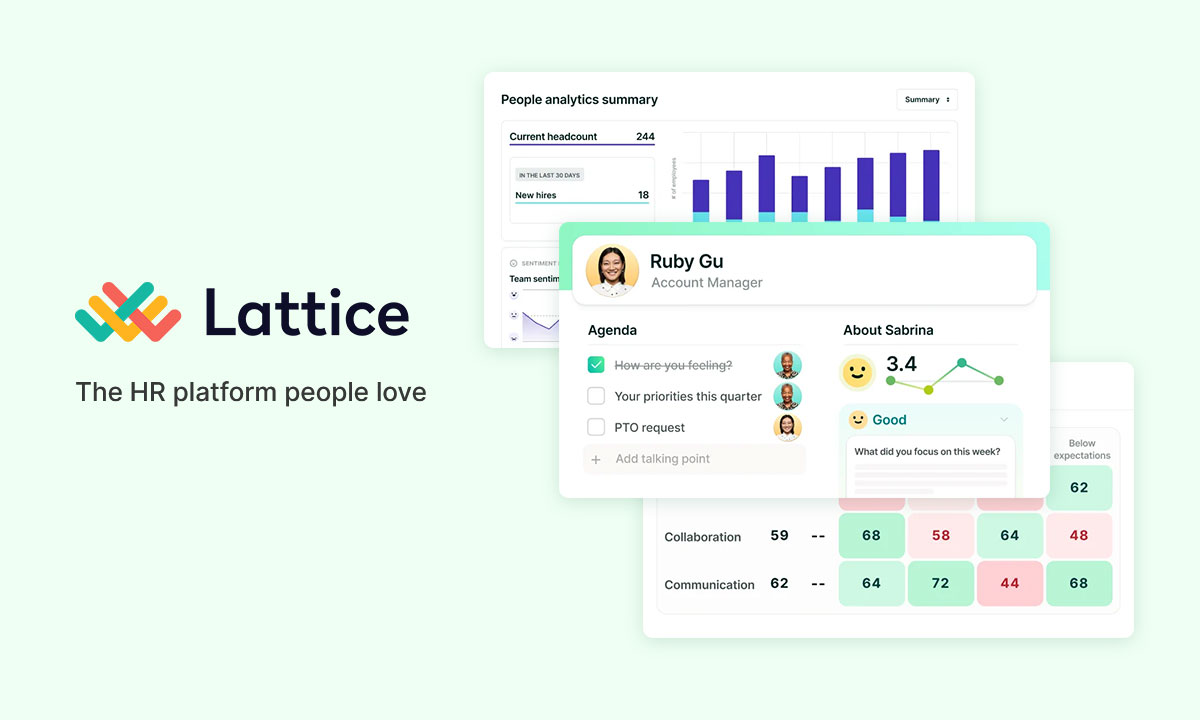
Lattice is the best-known name in the category and has the deepest people analytics. It ranks #1 organically for this keyword for a reason — but it's also the platform most often oversold to companies too small for it.
Key features: Reviews, goals and OKRs, engagement surveys, 1-on-1s, compensation management, career development frameworks.
Pricing: Foundations $13/seat/month billed annually with a $4,000 minimum annual agreement. À la carte: Performance $10, Goals & OKRs $8, Engagement $4. No free plan or trial.
Best for: Companies at 150–500 employees growing fast enough to need the ceiling.
Watch out for: The $4,000 floor. Lattice's own pricing page also contradicts itself on the unbundled Performance rate — $10 on the rate card, $8 in the FAQ. Get the number in writing.
7. BambooHR — Best All-in-One HR Platform

If you need reviews and payroll, time tracking, onboarding, and an employee database, BambooHR consolidates the stack. The performance module is competent rather than deep.
Key features: Self-assessments and manager reviews, goal tracking, full HRIS, payroll and benefits, onboarding workflows.
Pricing: Core is $10/employee/month, but performance management requires the Pro tier at $17/employee/month (Elite $25). Under 25 employees, a flat rate from $250/month. Free trial available.
Best for: Companies replacing several HR tools at once, where reviews are one requirement among many.
Watch out for: At $17/employee/month a 50-person company pays $10,200 a year, most of it for HRIS functionality. If you already have an HRIS, this is the wrong purchase.
8. Zoho People — Best for Tight Budgets
Zoho People is the cheapest route to a full HR system with performance attached, especially outside the US.
Key features: Performance appraisals, KRA and goal tracking, 360 feedback, plus attendance, leave, and employee records.
Pricing: Geo-split. Globally, performance sits in Premium at $3.50/user/month ($3.00 annually). In the US it's in Talent at $6/user/month ($5 annually). Free for up to 5 users, 30-day trial without a card. Five-user minimum.
Best for: Cost-sensitive teams and companies already using other Zoho products.
Watch out for: US pricing is roughly double the global lineup, and performance is not in the cheaper Essential HR tier — despite what several comparison sites claim.
9. Culture Amp — Best for Engagement-Led Performance
Culture Amp came from the engagement survey world and built performance on top of it. If your thesis is that performance follows engagement, the data model matches how you think.
Key features: Performance reviews and 360s, engagement and lifecycle surveys, goal tracking, people analytics, benchmarking against its survey dataset.
Pricing: Not published. Quote only, and the pricing page confirms all products are billed annually. No free plan or trial. Service tiers are segmented under 200, 200–999, and 1,000+ employees.
Best for: HR-mature organizations above roughly 200 people where engagement data drives performance strategy.
Watch out for: Performance is the newer half of the platform. Teams that need deep review workflows may find it thinner than a dedicated tool.
10. Leapsome — Best for Performance Plus L&D
Leapsome pairs performance management with learning paths and competency frameworks — unusual in this price band and genuinely useful if development sits in your remit.
Key features: Reviews and 360s, goals and OKRs, engagement surveys, 1-on-1s, learning modules and competency frameworks.
Pricing: Not published — quote only. Confirmed one-year minimum contract term. No free plan or trial.
Best for: Companies running a real L&D program that don't want a separate LMS. Strong with European teams.
Watch out for: No published price plus a one-year commitment means negotiating blind on both cost and duration.
11. Trakstar Perform — Best for Structured Appraisals
Now branded Mitratech Perform, Trakstar has run structured appraisals for over a decade. It leads with process rigor and reporting rather than AI.
Key features: Multi-source 360 feedback, customizable appraisal templates, goal tracking, automated reminders, detailed workforce reporting.
Pricing: Not published. No free plan, no trial. Custom quote only.
Best for: Organizations needing defensible, audit-ready appraisal records — regulated industries especially.
Watch out for: The interface is dated, and you can't evaluate cost without entering a sales cycle.
12. Workleap — Best for Engagement-First Teams
Workleap (formerly Officevibe) built its reputation on pulse surveys and manager-employee trust, then added performance. The engagement layer is excellent; performance is solid but secondary.
Key features: Pulse surveys and engagement analytics, 1-on-1 tools, performance reviews, goals.
Pricing: Standard from $4,999 USD per year — a flat platform fee, not per seat (Pro $11,999; Enterprise 250+ custom). Billed annually. No free plan or trial.
Best for: Companies above roughly 100 employees, where the flat fee works out to about $4/employee/month.
Watch out for: At 30 employees that same fee is $14 per employee per month. Flat pricing punishes small teams.
What Employee Appraisal Software Actually Costs
Run the numbers for a 50-person company, billed annually, using published rates:
- AssessTEAM: $1,200/year
- Effy AI: $1,800/year
- Small Improvements (Launch): $1,800/year
- Zoho People (global Premium): $1,800/year
- PerformYard (low end of range): $3,000/year
- Workleap (Standard, flat): $4,999/year
- 15Five (Perform): $6,600/year
- Lattice (Foundations): $7,800/year
- BambooHR (Pro): $10,200/year
Culture Amp, Leapsome, and Trakstar can't be placed on this list because none of them publish a rate.
The spread between cheapest and most expensive is 8.5x. Almost none of that gap is review quality — it's HRIS functionality, analytics depth, and how much of the platform you're buying that isn't reviews.
How to Choose
Three questions get you to a shortlist faster than any feature matrix.
What are you actually buying? If you need reviews only, the $1,200–$3,000 tier does the job. If you need payroll and an employee database too, BambooHR or Zoho People make sense. Buying a second HRIS to get reviews is an expensive way to solve a small problem.
What's your real price? Per-seat rate times headcount, compared against the vendor's minimum. Whichever is higher is what you pay. This single calculation removes half the market for companies under 50 people.
Will your managers use it? A tool at 90% completion beats a better tool at 40%. Before signing anything, run a pilot with three real managers and one real review cycle. Adoption is the only metric that survives contact with a busy quarter.
One caveat that applies to all twelve: software doesn't fix a broken process. If you don't have a rhythm for goal-setting and feedback yet, sort the performance review process first, then buy the tool that supports it.
Final Take
For most teams under 300 people, Effy AI is the strongest fit — published pricing, no minimums, no contract, and a cycle you can launch this week. AssessTEAM is the cheapest transparent option if budget is the binding constraint. BambooHR wins if reviews are one line item in a full HR consolidation, and Lattice is the right ceiling if you're heading past 200 employees quickly.
The four platforms that publish nothing — Culture Amp, Leapsome, Trakstar, and PerformYard's real number — may well be the right answer for you. Just budget the two weeks of sales calls it takes to find out.
Effy AI is free for up to 5 users, no credit card. Start a cycle and see it before you talk to anyone.
If you're buying for the whole HR function rather than one review cycle, the HR performance management software comparison sorts platforms by buyer type. Under 300 employees, the performance management software for small business list filters out anything with a seat minimum you can't clear. And the performance management systems guide covers the cycle the appraisal sits inside.
Effy AI runs 360° appraisals and reviews for teams without an HR ops function, with AI-assisted performance reviews and a small-business setup.
