

Here's the thing nobody says out loud about talent management software: of the twelve platforms below, exactly one publishes a price on its own website.
Cornerstone, ClearCompany, PeopleFluent, Eightfold, HiBob, PageUp and Workday all publish nothing. SAP prices its Core HR base but not its talent bundles. That's not an accident — talent management suites are sold, not bought, and the sales process is where the price gets set against what they think you'll pay.
So this guide does two things a feature list won't. It tells you which of the five talent modules each platform actually covers — recruiting, onboarding, performance, learning, succession — because "talent management" means different things to different vendors. And it's explicit about who publishes a rate and who doesn't, so you know how long your shortlist will take to build.
One more thing worth saying upfront: the top talent management software for a 5,000-person enterprise is not the top talent management software for a 120-person company. They aren't competing products. That's why the list below is grouped by what each platform is for, rather than ranked one to twelve.
TL;DR — What Each Platform Covers and Costs
Full-suite talent management systems — all five modules, enterprise scale, quote only.
- Workday — all five modules. Not published.
- SAP SuccessFactors — all five, split across separately priced bundles. Core HR $18/user/month; talent add-ons not published.
- Cornerstone OnDemand — all five plus skills and a talent marketplace. Not published.
- PageUp — all five, recruitment-led. Not published.
- Dayforce — talent inside full HCM. Publishes a real price book: $171.96/employee/year platform plus $72.48 for Talent Management.
Mid-market all-in-one — most modules, lighter, some published pricing.
- Namely — recruiting, onboarding, performance, payroll. $9/employee/month — the only outright published entry price here.
- BambooHR — performance requires the Pro tier at $17/employee/month.
- HiBob — hiring, onboarding, performance, learning. Not published.
- ClearCompany — recruiting, onboarding, performance, learning, engagement. Not published.
Specialists — deep in one area, not a full suite.
- Eightfold AI — recruiting and internal mobility, skills-led. Not published.
- PeopleFluent — performance, succession, learning, compensation. No ATS. Not published.
- Effy AI — performance and development only. $3/seat/month, free up to 5 users.
What Talent Management Software Actually Includes
A talent management system covers the employee lifecycle after you've decided you need someone, through to the point they're running the department. Vendors bundle five modules under the label, and almost nobody offers all five equally well.
- Recruiting and ATS — sourcing, applications, interview scheduling, offers.
- Onboarding — paperwork, provisioning, first-90-days structure.
- Performance — reviews, goals, 360 feedback, one-on-ones.
- Learning — course delivery, compliance training, skill development.
- Succession — 9-box, bench strength, leadership pipelines.
The label matters less than the coverage. PeopleFluent calls itself talent management and has no ATS. Eightfold calls itself talent management and has no performance reviews. Both are accurate by their own definition and useless if you assumed otherwise.
A note on terminology. Vendors use talent management software, talent management system software, and talent management platform interchangeably, and no capability difference is implied by any of them. Ignore the label and compare module coverage instead — it's the only thing that varies meaningfully between these products.
Before you shortlist anything, write down which of the five you actually need. Most companies need two or three, and buying all five is how organizations end up paying enterprise rates for modules nobody switches on.
Full-Suite vs Best-of-Breed: The Real Decision
This is the choice that determines your budget, not the vendor comparison.
A full suite puts all five modules in one system with one employee record. Data flows between recruiting and onboarding and performance without integration work, reporting spans the whole lifecycle, and you have one vendor relationship. You pay for all five whether you use them or not, and the individual modules are usually adequate rather than excellent.
A best-of-breed stack means an ATS you like, an HRIS for records, and a dedicated performance tool — connected by integrations. Each piece is better at its job and separately replaceable. You own the integration work and the multi-vendor admin.
The honest rule of thumb: below about 200 employees, best-of-breed usually wins on both cost and quality. The integration burden is small at that size and suite pricing is punishing — a 100-person company on a full suite is often paying more than the same company running a good ATS, BambooHR and a dedicated performance tool.
Above 1,000, suites start winning on data consistency and reporting, and the integration overhead of six vendors becomes a real cost.
Between those, it depends on whether you have anyone to own integrations.
We build the performance layer of that stack, so treat the recommendation as coming from an interested party — but the sizing logic holds regardless of which performance tool you pick.
Full-Suite Talent Management Systems
1. Workday — Best for Large Enterprises
Workday is the default enterprise answer and the most complete talent management system in the category — talent acquisition, performance, learning, succession and onboarding on one record, alongside payroll and workforce management.
Modules: All five.
Pricing: Not published. Workday's only pricing page covers Adaptive Planning, a financial product, and even that says "pricing varies." No trial for HCM or Talent.
Best for: Organizations above roughly 3,000 employees with a dedicated HRIS team.
Watch out for: Implementation is a partner-led project measured in quarters. G2 rates Workday Talent Management 4.4 from only 77 reviews — the broader HCM profile sits at 4.1 from 1,709.
2. SAP SuccessFactors — Best Inside an SAP Estate
SuccessFactors covers the full lifecycle, but it's assembled from separately licensed bundles rather than sold as one thing. That modularity is genuinely useful if you only want two of the five.
Modules: All five, split across Recruiting/Onboarding, Learning & Career Development, and Pay for Performance bundles.
Pricing: SAP Core HR is $18/user/month, sold in blocks of one user on 1–3 year contracts with auto-renewal. The talent bundles on top are not published — both are "contact sales." Certified partner implementation is mandatory and unpriced.
Best for: Organizations already running SAP.
Watch out for: The published $18 is Core HR, not talent. Budget the bundles and partner implementation separately, and expect the latter to dominate year one.
3. Cornerstone OnDemand — Best for Learning-Led Talent Strategy
Cornerstone came from the LMS world and remains strongest there. If learning and skills development are the centre of your talent strategy rather than an afterthought, it's the most credible suite.
Modules: All five, plus a skills engine, content library and internal talent marketplace.
Pricing: Not published. The pricing URL now redirects to the learning product page, and the FAQ directs you to sales for an estimate. The old SMB tier is discontinued.
Best for: Enterprises where compliance training and upskilling drive the business case.
Watch out for: There's no defensible G2 score for the talent suite — the only live profile is Cornerstone Learning at 4.1 from 530 reviews.
4. PageUp — Best for Recruitment-Led Organizations
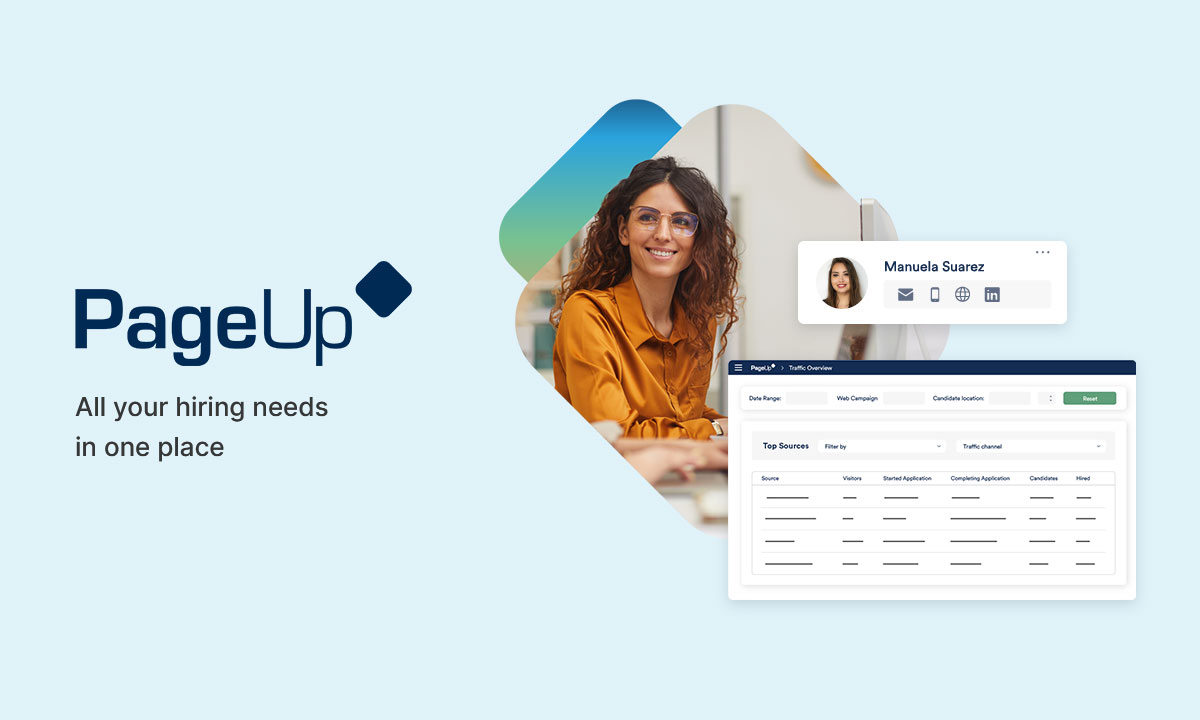
PageUp approaches talent management from the hiring end, which suits high-volume recruiters in healthcare, education and government.
Modules: All five, with recruitment marketing and ATS as the strongest.
Pricing: Not published. The pricing URL redirects to the homepage.
Best for: Organizations where hiring volume, not review cycles, is the operational challenge.
Watch out for: 141 G2 reviews is modest for an enterprise commitment, and the performance module is not the reason to buy it.
5. Dayforce — Most Transparent Enterprise Option
Dayforce is the only enterprise vendor in this category that publishes a downloadable price book. Whatever you conclude about the product, you can build a budget without a sales call — which none of its competitors allow.
Modules: Talent management inside full HCM, including payroll and workforce management.
Pricing: Published MSRP per employee per year: Platform $171.96 (required), Talent Management package $72.48 covering performance, compensation, succession and engagement. Performance alone is $33.96. Implementation services listed separately.
Best for: Organizations above roughly 1,000 employees wanting HCM and talent together.
Watch out for: The platform SKU is mandatory, so talent management realistically starts at $244.44 per employee per year — about $20 a month.
Mid-Market All-in-One Platforms
6. Namely — Only Vendor Here Publishing an Entry Price
Namely combines HR, payroll and benefits with recruiting, onboarding and performance, aimed squarely at mid-market US companies.
Modules: Recruiting, onboarding, performance. No learning, no succession.
Pricing: From $9 per employee per month on the Namely Now tier, with no published employee-count minimum and contracts from month-to-month up to three years. No free plan or trial — the "guided tour" is a demo.
Best for: US mid-market companies of 50–1,000 that want payroll and talent basics together.
Watch out for: 3.9 on G2 from 334 reviews is the weakest score in this list. No learning or succession, so it's not a full suite despite the positioning.
7. BambooHR — Best HRIS-First Option for Smaller Teams
BambooHR is the most widely adopted HRIS in the small and mid-market, with performance bolted on competently rather than deeply.
Modules: Onboarding, performance, plus full HRIS, payroll and benefits. Hiring available; no real learning or succession.
Pricing: Core $10/employee/month, but performance requires the Pro tier at $17/employee/month (Elite $25). Under 25 employees, a flat rate from $250/month. Free trial available.
Best for: Companies of 25–500 replacing spreadsheets with a proper HR system.
Watch out for: You're buying an HRIS that does performance, not a talent management system. If you already have an HRIS, this is the wrong purchase.
8. HiBob — Best for Culture-Led Mid-Market Teams
Bob is the design-led option, strong on engagement, org charting and the social side of HR. Popular with tech companies of 100–1,000.
Modules: Hiring, onboarding, performance, learning, plus payroll, compensation and workforce planning. No dedicated succession module.
Pricing: Not published. The pricing page is a three-step quote form; the FAQ confirms per-employee pricing without giving a rate.
Best for: Distributed, culture-conscious teams that will actually use the engagement features.
Watch out for: Quote-gated, so it can't be compared on price without a sales conversation.
9. ClearCompany — Best for Recruiting-Plus-Performance
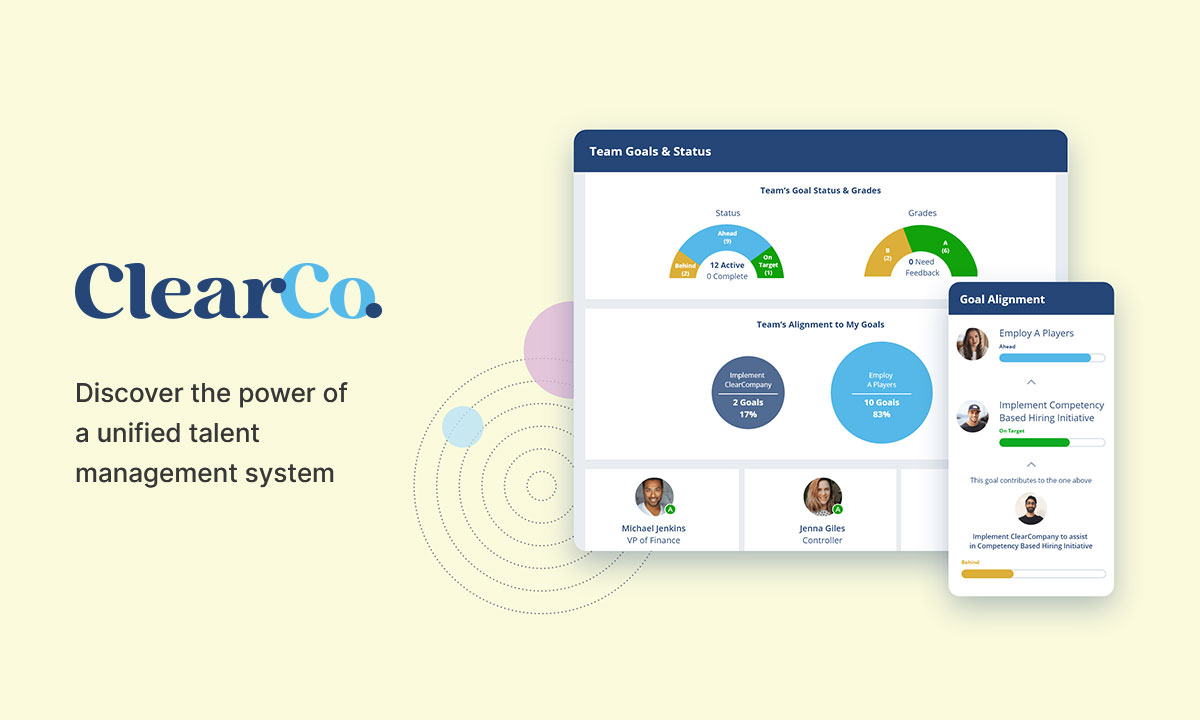
ClearCompany packages talent modules separately — ClearRecruit, ClearTalent, ClearGrow, ClearLearn — so you can buy the parts you need.
Modules: Recruiting, onboarding, performance, learning, engagement and compensation. No dedicated succession module.
Pricing: Not published. Packages are listed with "get pricing" forms and no figures.
Best for: Mid-market companies where hiring and performance both matter and learning is a nice-to-have.
Watch out for: 4.6 on G2 from 507 reviews is strong, but the modular packaging means the quote depends entirely on which bundles you're steered toward.
Specialists Worth Knowing
10. Eightfold AI — Best for Skills and Internal Mobility
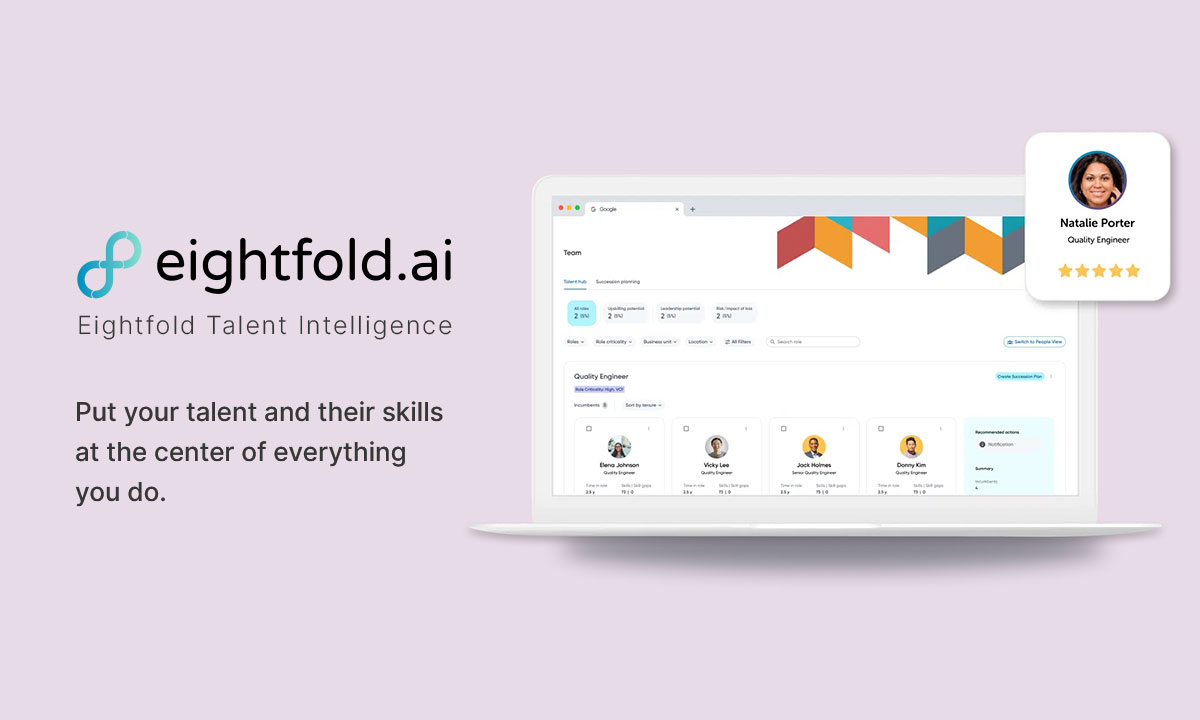
Eightfold is a talent intelligence platform rather than a talent management suite. It matches people to roles using a skills graph, which is genuinely differentiated for internal mobility and high-volume recruiting.
Modules: Recruiting/ATS and internal mobility. No classic performance review, onboarding or succession modules.
Pricing: Not published. The pricing URL returns a 404, and the vendor's own pricing blog post contains no figure.
Best for: Large organizations solving a sourcing or redeployment problem, not a review-cycle problem.
Watch out for: Don't shortlist this against Workday or Dayforce — it isn't the same category, despite the shared label. 4.2 on G2 from 224 reviews.
11. PeopleFluent — Best for Compensation and Succession Depth
PeopleFluent, part of Learning Technologies Group, is strong in structured performance, succession and compensation planning for large, complex organizations.
Modules: Performance, succession, learning, compensation, org charting. No ATS, no onboarding.
Pricing: Not published. The pricing URL redirects to the homepage.
Best for: Large enterprises with mature comp and succession processes.
Watch out for: PeopleFluent no longer has a G2 product profile at all, which makes independent validation difficult.
12. Effy AI — Best for the Performance Layer
{{banner-3="/banner-page"}}
Effy AI is not a talent management suite, and it's worth being direct about that. It covers performance and development — reviews, 360 feedback, goals, one-on-ones, development plans — and nothing else. No ATS, no payroll, no LMS.
That's the point. Most companies under 300 people don't need a suite; they need an ATS, somewhere to keep employee records, and a performance tool that people actually use. Effy is the third piece, priced so it doesn't need a business case.
Modules: Performance and development only.
Key features:
- AI-generated review forms and written summaries
- 360° feedback, self-assessments, manager and peer reviews
- Bias checks and quality nudges on written feedback
- Goals and OKRs, development plans, check-ins
- Heatmap and 9-box talent review insights
- Runs inside Slack
Pricing: Free for up to 5 users. From $3/seat/month billed annually. No minimums, no contracts, no implementation fees. See full pricing.
Best for: Companies of 10–300 building a best-of-breed stack rather than buying a suite.
Watch out for: If you genuinely need recruiting, learning and succession in one system, this isn't it — look at the suites above.
What Talent Management Software Costs
Only three vendors here publish enough to price a 200-person company:
- Effy AI (performance layer only): $7,200/year
- Namely (Now tier): $21,600/year
- BambooHR (Pro): $40,800/year
- Dayforce (Platform + Talent Management): $48,888/year
SAP's published Core HR rate alone would be $43,200/year for 200 people, before any talent bundle or mandatory partner implementation.
Workday, Cornerstone, PageUp, HiBob, ClearCompany, Eightfold and PeopleFluent cannot be placed on this list. None publish a rate.
The practical consequence: building a like-for-like shortlist in this category means five to seven sales conversations before you can compare anything. Budget two to three weeks for that, and start the conversations before you need the software.
How to Choose the Top Talent Management Software for Your Company
Write down which of the five modules you need. Not which sound useful — which you'd notice missing in six months. Most companies need two or three. This single step eliminates most of the market.
Decide suite or stack before you take demos. Otherwise you'll be sold a suite, because that's what suite vendors sell. Under 200 employees, price a best-of-breed stack first and make the suite justify the difference.
Check the module you care about most, specifically. Every suite has a weak module. If performance is your priority, ask to see a full review cycle end to end, not a dashboard screenshot — that's where the thin implementations show.
Treat quote-only as a cost, not a neutral fact. Seven of these twelve won't tell you a price without a call. If you're an HR team of one, that time is real.
Pilot before you sign. A suite nobody adopts is more expensive than the tool you rejected on features. If a vendor won't support a pilot, that tells you something about the implementation.
Effy AI is free for up to 5 users, no credit card. Start a cycle and see the performance layer working before you commit to anything larger.
